


.webp)
.webp)
 store
store


-4°C Snow Trek on Ancient Trail: AlpWalk's Exoskeleton Completes 3-Hour Field Test
Product News
January 7, 2025
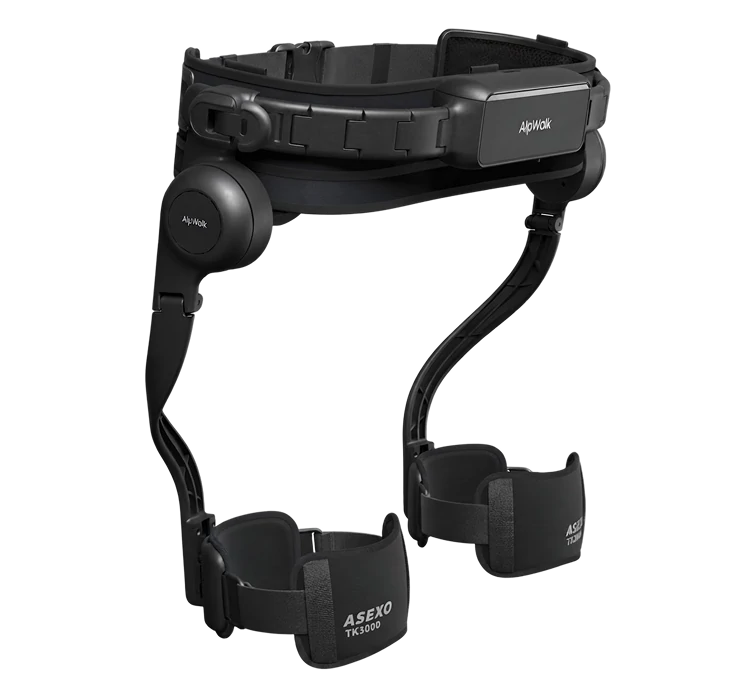
In early 2025, a heavy snowfall blanketed the Wuyue Ancient Trail in Lin'an, Zhejiang Province, China. In temperatures as low as -4°C, the AlpWalk R&D team took its hip‑assistive walking exoskeleton to this ancient trail – which reaches an elevation of 1,140 meters and stretches approximately 35 kilometers – for a three‑hour outdoor field test.

“For the first few minutes, we were all carefully watching the system’s responses, afraid of making any mistake,” recalled one of the team members. “But very soon we found that the exoskeleton adapted perfectly to these extreme conditions – it performed almost as steadily as it did in the lab.”
This test was all about seeing how the exoskeleton handles low temperatures, rough terrain, and long hours of use. The Wuyue Ancient Trail features constantly changing elevations, with snow-covered stone steps, gravel paths, and icy patches alternating along the route – making it an ideal testing ground for the device in real-world conditions.
Throughout the test, the exoskeleton’s power system responded swiftly to the changing surfaces, adjusting its assistive output in sync with the user’s gait. “It feels like someone is pushing you forward from the waist,” the tester remarked mid-hike. “After three hours on the trail, it felt more like one.” On the uphill sections and longer stretches, the hip-assistive support took a noticeable load off the leg muscles, making fatigue after prolonged walking significantly lower than usual.

Another key focus of the test was the device’s stability in freezing conditions. Over the full three hours, the exoskeleton kept running smoothly. The sensors didn't drift, and the cold never slowed it down.. Even at the end of the trial, the unit still had battery power remaining. “On the last kilometer, my phone battery dropped from 80% to 5%, but the exoskeleton still had charge,” the tester noted, tapping the motor module at his waist. “The endurance turned out even better than we expected.”
When the team unloaded the equipment by Tianchi Lake, snow had accumulated on the metal frame, but the blue status indicator lights on the device continued to blink steadily. For the R&D team, this was just one routine step in the product’s journey to maturity – yet it was a moment worth recording. When they reached the summit two hours ahead of other hikers who were stuck midway, they reaffirmed a simple conviction: a truly good product is not born solely in a temperature‑controlled lab; it must prove itself in the harshest real‑world conditions.

AlpWalk will continue to push forward with field validation, using real‑world data to drive iterative improvements, and bringing intelligent walking‑assist technology from the laboratory into broader applications – including outdoor work, elderly mobility support, and everyday travel.


Recommended Reading
-
 Company News April 20, 2026AlpWalk Showcases Exoskeleton Lineup to High Demand at Hannover Messe
 -
 Company News March 11, 2026AlpWalk AI-Powered Walking Assist Exoskeleton Wins Top Honor at Geneva International Exhibition of Inventions
 -
 Product News September 5, 2026FOR THE BOUNDLESS WALK: AlpWalk S1 Hip-Assistive Exoskeleton at IFA Berlin 2026